
Why Can’t Swift Optionals Directly Equal nil?
When I first started learning Swift, I was confused by nil many times.
In Objective-C, nil is a pointer to an empty object — you can freely set objects to nil.
But in Swift, regular variables can’t be assigned nil — only optionals can.
My first reaction was: “It’s just an empty value — why make it so complicated?”
This question reveals how Swift rethought the concept of “nothing” — moving from “runtime null pointers” to “compile-time type systems.”
This article avoids abstract theory and starts from the essence of nil to explain why optionals can’t directly equal nil.
1. The Difference Between Swift and Objective-C

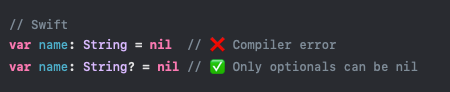
Why the difference? Because Objective-C and Swift define “nothing” completely differently.
In Objective-C, nil is a pointer to address 0x0. Because Objective-C is dynamic, sending a message to nil doesn’t crash — it just does nothing. Any object pointer can be assigned nil — it’s a runtime convention.
In Swift, nil is not a pointer. It’s a value representing the absence of a value. Regular variables must store a valid value and can’t store “absence.” Only Optional — a special container type — can store either “some value” or “none.”
In one sentence: Objective-C’s nil is a “pointer to nothing,” Swift’s nil is the “absence of a value.” They are fundamentally different.
2. What Is Optional, Really?
Optional is an enumeration in Swift:
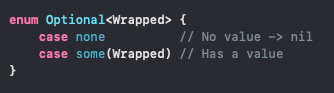
So var name: String? = nil is actually var name = Optional<String>.none. nil is syntactic sugar for Optional.none.
String and String? are not the same type — they’re two different types. String? is shorthand for Optional<String>.

b and c have the same type: Optional<String>. The difference is that b‘s state is .some("hello"), while c‘s state is .none.
This is why a regular String can’t be assigned nil: regular String has no .none state. Only the Optional enum has the .none case.
3. Why Design Optional as an Enum Instead of Allowing Anything to Be nil?
If Swift allowed any type to be nil, it would cause several serious problems.
The first problem is that the type system would become imprecise. If a function is declared to return String, callers don’t need to worry about it returning nil. But if any type could be nil, callers would have to check for nil every single time. Swift’s design philosophy is: “nullable” should be explicitly marked in the type, not implicitly present in all types.
The second problem involves the difference between compile-time safety and runtime safety. Encoding “nullability” into the type system allows the compiler to catch potential issues at compile time:
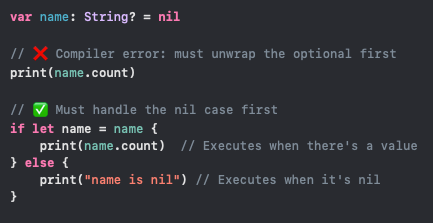
This is safer than runtime null pointer exceptions. Most modern languages are moving in this direction — Rust’s Option, Kotlin’s nullable types, and Swift’s Optional.
The third problem is preventing implicit nil. In Objective-C, any object pointer can be nil, but callers can’t tell from the function signature. Developers rely on documentation or guessing to know whether a return value might be nil, leading to defensive code and potential null pointer crashes. Swift marks nullability explicitly in the function signature, making it clear at a glance:

4. A Real-World Scenario: Parsing API Responses
Here’s a real case from my project. In the API response JSON, the user field might be null or an object:
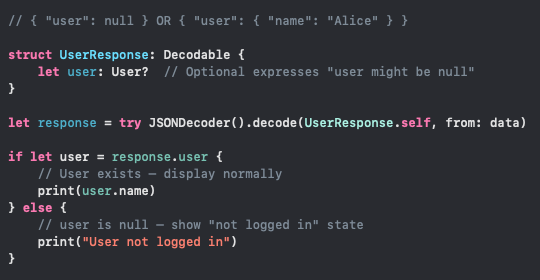
If Swift allowed any type to be nil like Objective-C, the decoder couldn’t distinguish between “this field is nil” and “this field doesn’t exist.” With Optional, the two states are clear — user could be .none or .some(value), and the type system forces you to handle both cases.
5. Pitfalls I’ve Run Into
The first pitfall is checking if x == nil but forgetting that the type is optional. Even when name is clearly not nil, this kind of check can lead to logic errors. The correct approach is to use if let or guard let for unwrapping, letting the compiler handle it for you.
The second pitfall involves optional as function parameters with default values. Giving an optional parameter a default value of nil and unwrapping it inside the function allows callers to either skip the parameter (using the default nil) or pass a specific value when needed. This pattern is extremely useful for handling “optional configuration” parameters.
The third pitfall is overusing explicit unwrapping (!). ! feels convenient in the moment, but if the value is nil, it crashes. My current rule: use ! only when I’m absolutely certain a value exists; otherwise, use if let or guard let. During code reviews, whenever I see a !, I always ask: “Is this value guaranteed to never be nil?”
6. Summary
Swift’s nil and Objective-C’s nil are fundamentally different. Objective-C’s nil is a null object pointer — a runtime convention. Swift’s nil is syntactic sugar for the .none case of the Optional enum — part of the compile-time type system.
Regular variables can’t be assigned nil because they don’t have a none state. Only the Optional enum has the .none case. So String can’t be nil, but String? can.
The core value of this design is safety. Encoding “nullability” into the type system lets the compiler check it for you, rather than waiting for a runtime crash. Swift transforms “empty value” from “a potential crash hazard” into “a normal state that must be explicitly handled.”
If an interviewer asks this question, you can answer from three angles: the type level — nil is syntactic sugar for Optional.none; the safety level — the compiler enforces nil handling to prevent crashes; and the design philosophy — Swift requires precise types, distinguishing between “has a value but we don’t know what it is” and “there is no value at all.” Explain these three points clearly, and the interviewer will be satisfied.